So far in this issue, we have made the case that phasing out cars is both necessary and possible. Chapters 1 and 2 exposed the extraordinary impact of mining to humans, ecosystems, and as a major contributor to climate change. The only solution to the problems of mining is to do less of it.
____________________________________
Issue 2: Green energy & electric cars
Intro: Why does green energy produce so much toxic waste?
Chapter 1: Comparing wind, solar, nuclear & geothermal energy; mining waste
Chapter 2: The human and environmental costs of green energy mining
Chapter 3: Phasing out cars (even electric ones) to save the planet
Chapter 4: Your life would be way better if we phased out cars
Extra: Hydroelectric is not green energy
Bonus 1: Planet-saving green energy technology we foolishly never developed
Bonus 2: How did Congo (the world’s leading cobalt producer) get the way it is?
Bonus 3: The Congo Wars (1996-2003) and its millions of victims
_____
Issue 2 is available in written and podcast format
__________
But green energy requires minerals by the ton. How can we phase out fossil fuels with less mining?
In Chapter 3, we saw that electric cars will account for the bulk of mineral and energy use in a full green energy transition, so any reduction in car use will lead to a disproportionate reduction in humanity’s resource needs. Environmental and human impacts of mining aside, phasing out cars is a climate imperative: experts are unanimous that we will not be able to build 350 million electric cars to replace all the gasoline-powered cars in the US, plus build out all the electricity generation needed to run them in time to avoid catastrophic climate change.
Giving up our ability to get around to save the planet sounds dire. Fortunately, Chapter 3 also pointed out that mobility, booming economies, thriving culture, scientific advances, and a good life are possible without cars. For some of the most desirable places to live – New York, London, Paris, Amsterdam, Tokyo – car ownership is unusual. Clearly, if we phased out cars, you would still be able to get from place to place. In 1910, every American town of 10,000 or more had at least one streetcar line, and even small towns were connected to each other by rail. There were no cars, but people had great mobility. Recreating a similar transportation system today would allow us to successfully phase out fossil fuels without losing our ability to get around.
In this chapter, we pitch a much more difficult case: not only is it possible to phase out cars and maintain our mobility, but your life would actually be better without them.
Much driving isn’t actually important
Phasing out cars sounds impossible until we start looking more closely at people’s driving habits. It turns out that a large portion of driving trips can easily be taken by other means of transportation. We can see this demonstrated in several ways, but the most shocking are a handful of natural experiments. In 1973, a section of New York City highway collapsed, necessitating the entire highway to be closed for more than a decade. Because the highway carried 70,000 car trips each day, Manhattan was expected to be inundated with congestion as the 70,000 daily car trips would now have to move onto city streets.
But there was no increase in congestion whatsoever: 70,000 daily car trips simply disappeared, literally overnight. There’s no way to know what happened, but most of the disappearing car trips were probably replaced by trips on public transit.
Similarly, when San Francisco’s Embarcadero freeway was torn down, there was a brief increase in congestion, then a permanent 15% increase in public transit ridership.
But San Francisco and New York have the best public transit systems in the country. Perhaps cars can be phased out only in these special places? Not so. Even where there isn’t reliable public transit, cars can undergo this quick disappearing act. In 2010, the six-lane bridge over the Ohio River connecting Louisville, Kentucky, to Jeffersonville, Indiana, was frequently at a standstill with 120,000 cars crossing daily. To alleviate the congestion, Kentucky and Indiana together spent $1 billion to build a second bridge, also six lanes. To recover some of the costs, a toll of $1-4 per crossing was introduced, with commuters able to receive discounts. Now, only 60,000 cars make the crossing daily: double the capacity, half the cars. Apparently, a substantial portion of car trips were so unimportant to the drivers that they weren’t even willing to pay a few dollars. In Seattle, the closure of a viaduct that carried 90,000 cars per day didn’t lead to the predicted gridlock in downtown Seattle; instead, Seattle actually saw less traffic. As soon as a tunnel was opened to replace the viaduct, traffic returned to “normal.” In sum, natural experiments prove that much driving is not necessary and many trips are not even worth a few dollars or a little extra inconvenience to the driver.
This is not the only evidence that many car trips are unnecessary. A study of eight parking cash-out programs (wherein employers offer a cash bonus to employees who carpool or do not drive to work) reduced the number of employees who alone drove to work by 11% on average (p66). Some cash benefits were as little as $55 per employee per month, or a tiny $2.50 per workday (table 4-1, cases 6 & 8). For another example, Seattle Children’s Hospital started charging $3.25 to $11.50 per day to park and offered a $4.50 per day bonus to people who commuted by transit, bike, walking, or carpool; the share of employees riding alone to work fell from 73% to 37%. Clearly, much driving is not necessary because an incentive of just a few dollars is all that is needed to persuade a substantial number of people not to drive.
Finally, as discussed in Chapter 3, according to the Department of Transportation, 16.4% of all car trips in the US are 1 mile or less, and 27.7% are 2 miles or less, meaning they could be easily taken by walking. And a majority of trips are under 6 miles, meaning they could be easily taken by bike. Indeed, biking 1 mile is always faster than driving 1 mile because bikers don’t have to find a parking spot.
So far, our plan to phase out cars is off to a good start. Even before expanding access to public transit, bike, and walking infrastructure, much driving is already not necessary because so many car trips are very short, where a few dollars is enough incentive to dissuade people from driving.
Cars only provide the illusion of convenience
Though provocative, this evidence is a far cry from the case we promised to make: that your life would be better off by eliminating cars. After all, cars are extremely convenient: they’re better than walking because you can go further; they’re better than buses or trains because they take you directly from your starting point to your destination; they’re better than bikes because they move more quickly.
However, none of this is quite true.
Cars only provide the illusion of convenience. If cars are the most convenient form of transportation, it is because we have heavily subsidized them and built our world to accommodate them. Absent this subsidy, cars would be an exceptionally inconvenient mode of transportation. If we can understand these areas of subsidy, it will become clear that we can design a substantially more convenient transportation system by phasing out cars.
Totally spacing out
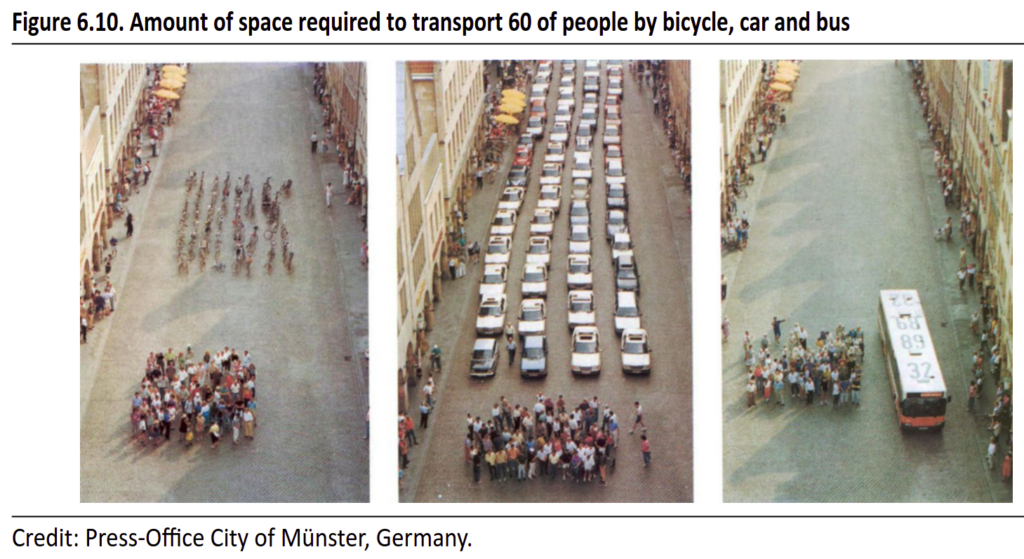
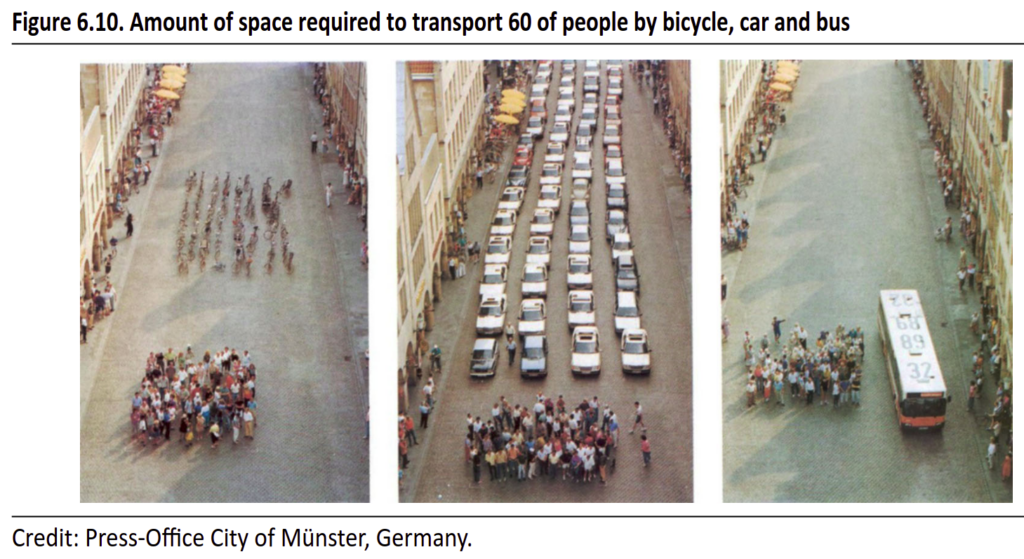
The first way our world heavily subsidizes driving is by making room for all the space cars need. Roads must take up more physical space in order to accommodate large numbers of cars moving through them, and this is dramatically illustrated by a photo that shows the space requirements of moving 60 people by bus, bike, and car:
This was recreated by the Cycling Promotion Fund for 60 people:
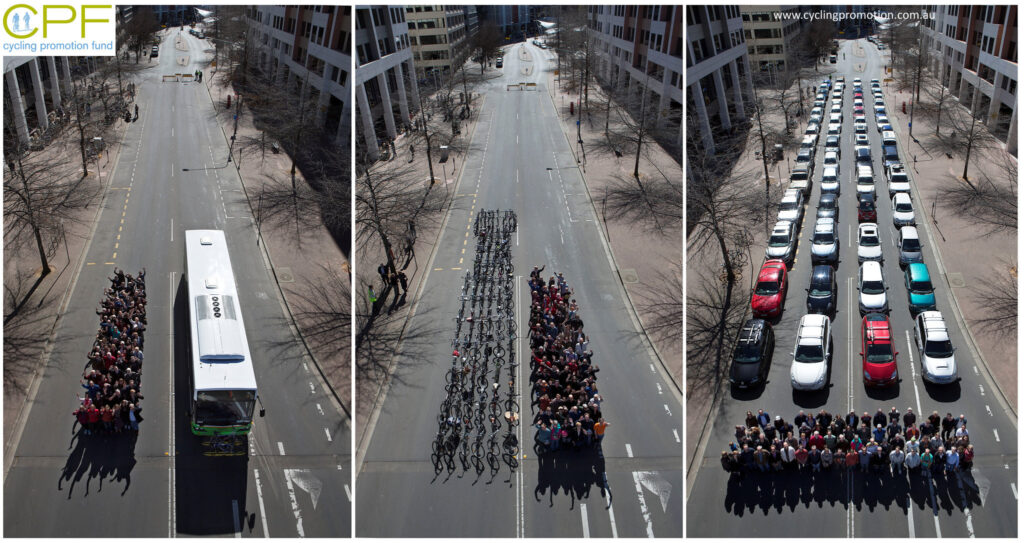
Buses are larger than cars, but there are so few buses relative to cars that they do not contribute to congestion. Even for a well-served route, a single bus passes every 10 to 20 minutes – so infrequently that buses have negligible contribution to congestion. Were buses the only traffic on a road, and one lane in each direction, without turning or parking lanes, would be more than adequate. But to keep cars moving requires more lanes, plus turning lanes in intersections.
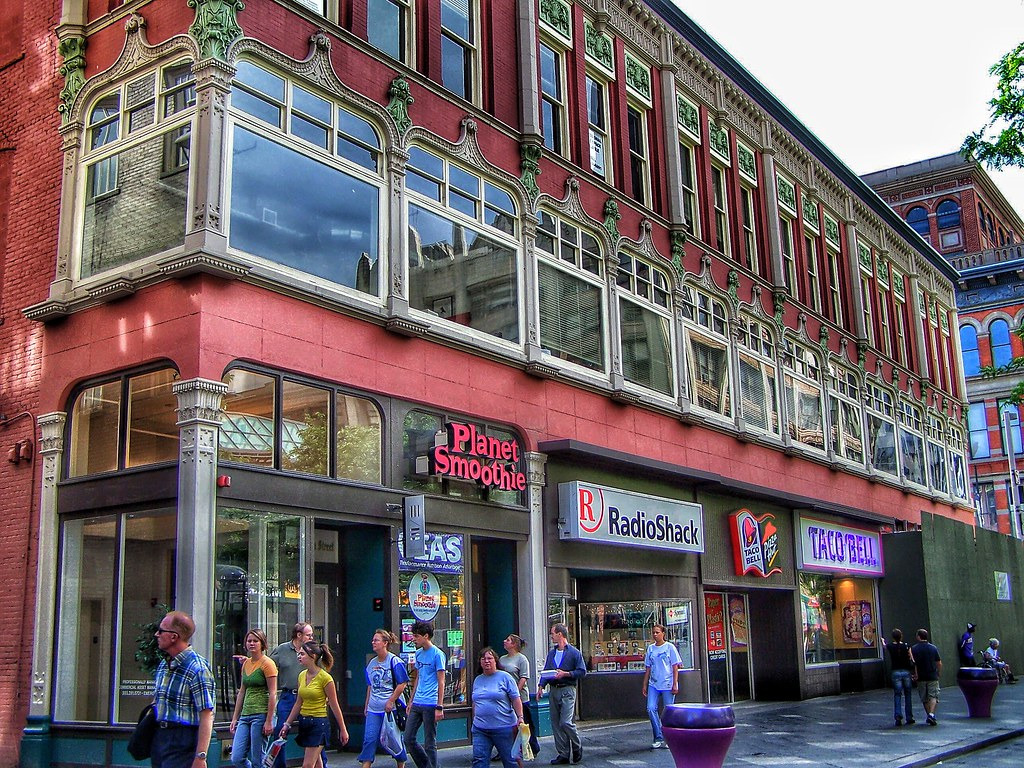
The second consequence of the cars’ space requirements is even more significant: parking spots. If the only mode of transportation were walking or riding a bus, there would be no reason to have space between any buildings. In fact, it would be most convenient for our various destinations (grocery store, dentist, hardware store) to be as close together as possible. Indeed, any place that was developed before cars became widespread is built in this way: as compact as possible in order to be as convenient as possible for people walking or taking streetcars (now, buses), as shown in this next photo:
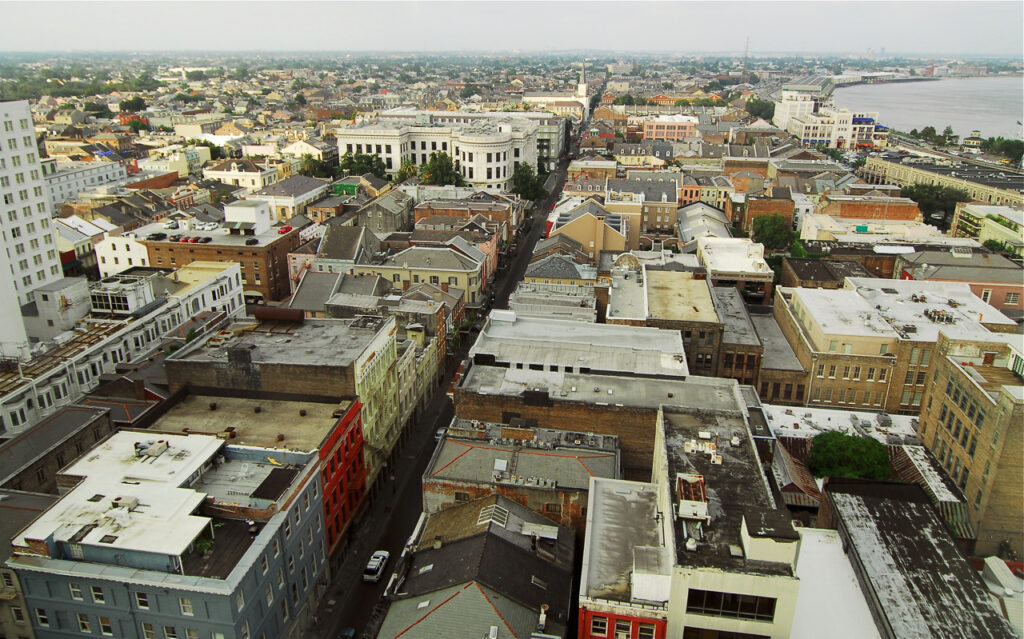
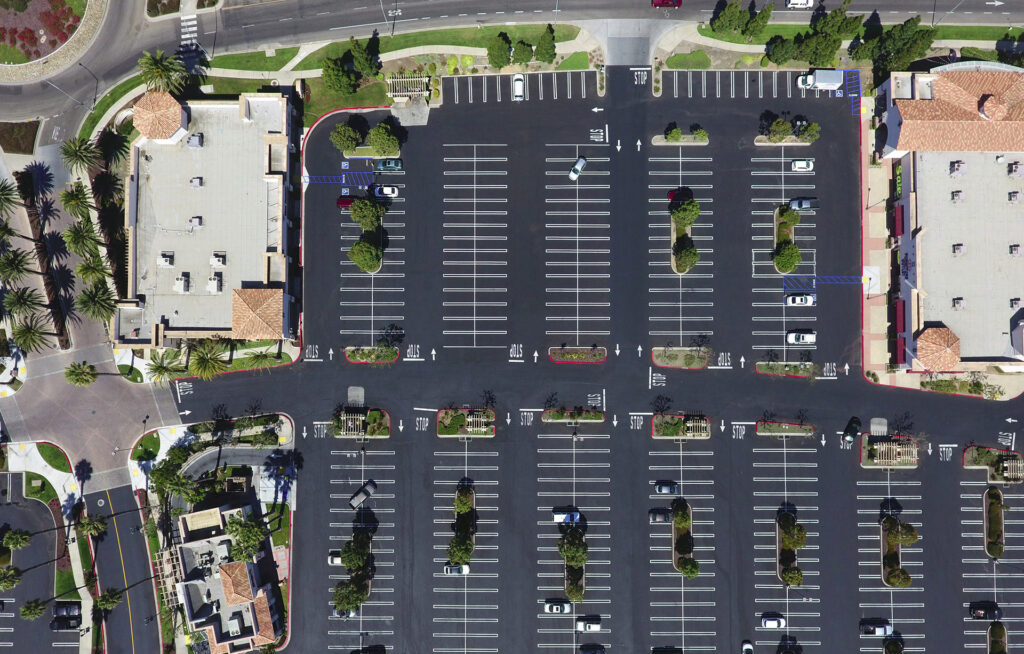
But that convenience for walkers and bus riders is actually a massive inconvenience for drivers because the lack of space between buildings means there is nowhere to park, as illustrated in the next two photos:

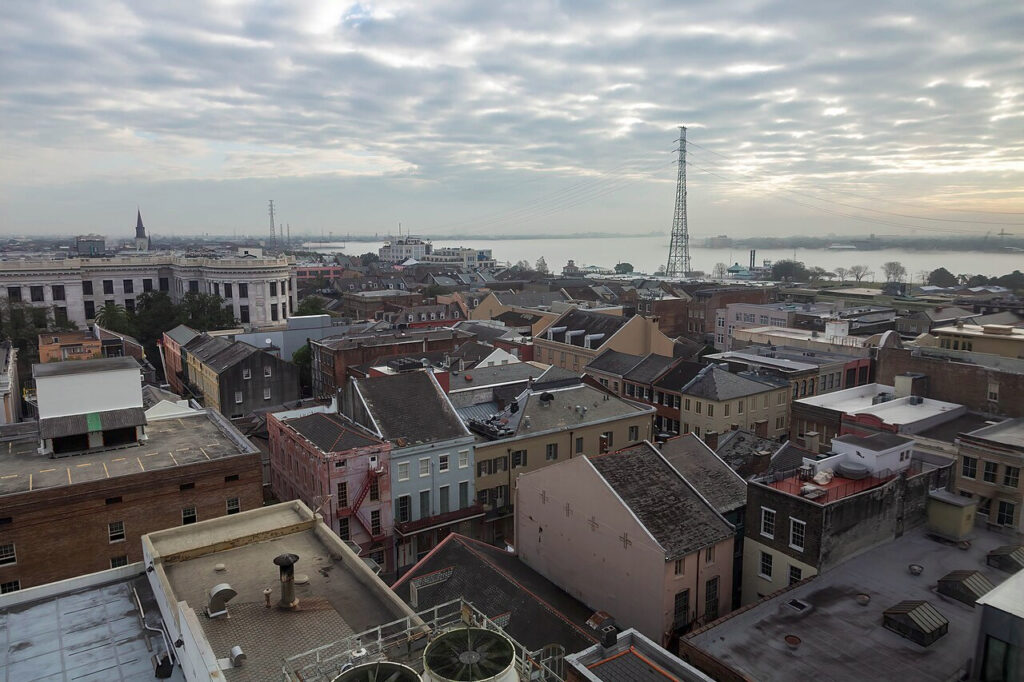

To understand the implications of the spatial needs of cars, let’s look once again at the photo showing the space requirements of different modes of transportation:
Cars take up so much space that, in order to ensure that anyone who drives there can find a place to park, more space is devoted to parking than to the destination itself. This is vividly illustrated in the next two photos.

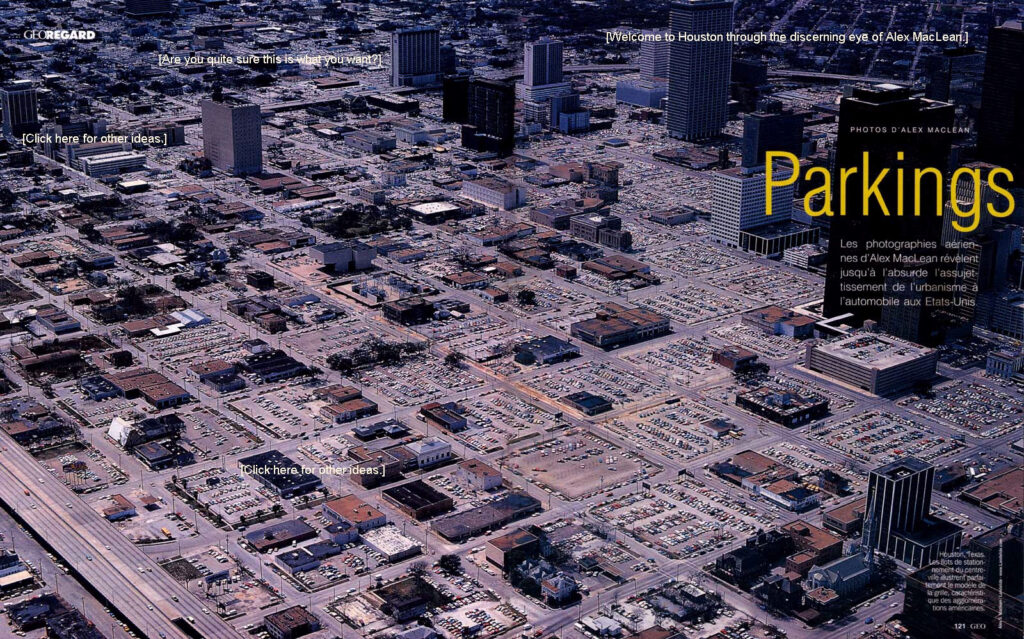
The amount of space taken up by parking spots is extraordinary. It is estimated that parking spots alone in the Houston metro area take up the same amount of space as Paris times ten. The following photo of downtown Houston gives an idea of what this actually looks like:
Putting this all together – more space taken up by wider roads and turning lanes to accommodate the space requirements of cars, plus all the space taken up by parking spots – a world built for cars is a world that must be very spread out. Since the 1950s, the US has been remade from a compact world built for walking and streetcars to a sprawled out world built for cars.
But by spreading everything out to accommodate the spatial needs of cars, the distance between all the places we need to go became larger and larger. In other words, it became more difficult – if not impossible – to walk, bike, or take public transit to get around. Everyone’s commute became longer in order to make it convenient for drivers. This was summed up by Samuel Schwartz, former NYC traffic commissioner, who explained how New York learned this the hard way: “No matter how many roads we built, or how well, people weren’t getting from point A to point B any faster, because points A and B were getting further apart…transportation had fallen into a vicious cycle in which more and more resources were being spent to less and less effect.” In other words, the more New York was rebuilt to accommodate cars, the more spread out everything got, and there was no way to move people more efficiently by car because the trips necessarily had to keep getting longer.
In sum, cars only provide the illusion of convenience because our world has been redesigned to accommodate them so completely. Prior to deliberate public policy to encourage car ownership – from the advent of the highway system in the 1950s to minimum parking spot ordinances – the world was more compact and could not support cars as a means of transportation. Cars only seem like the most convenient form of transportation because we have fundamentally altered our world from a compact design where driving is extremely inconvenient…
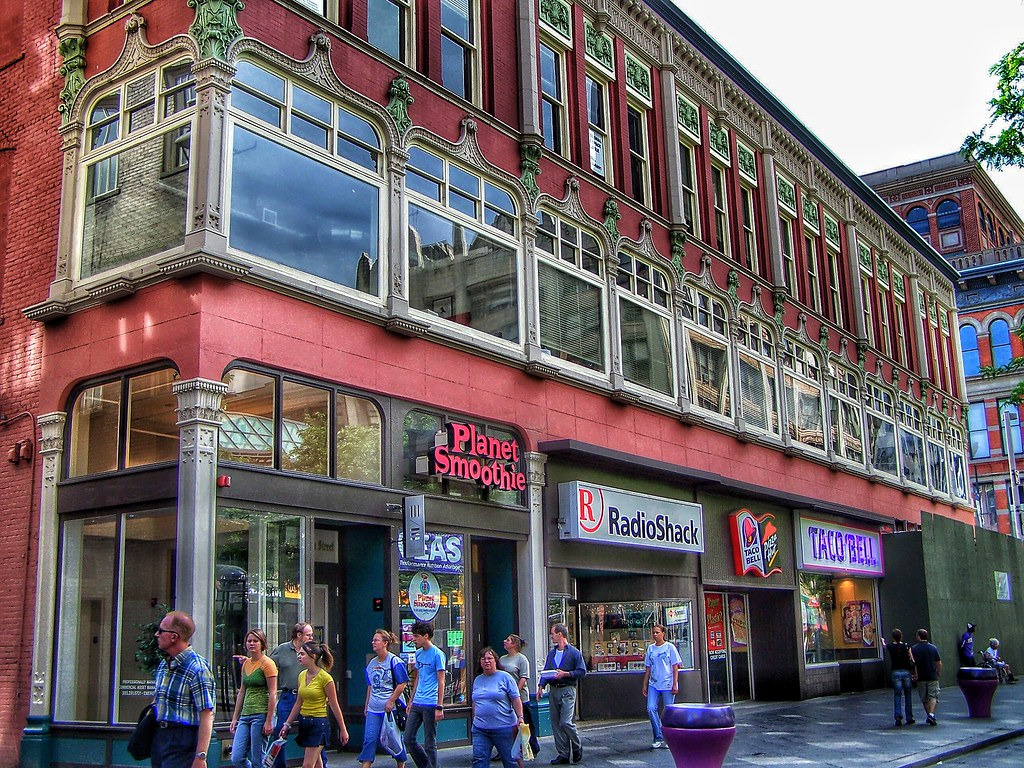
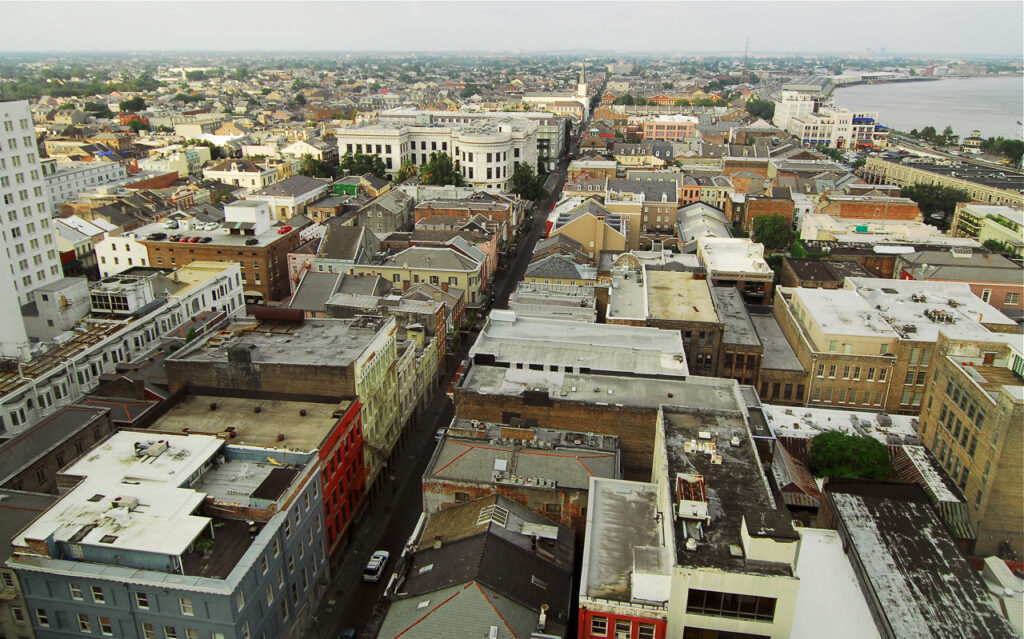
…to a design where only driving is practical:
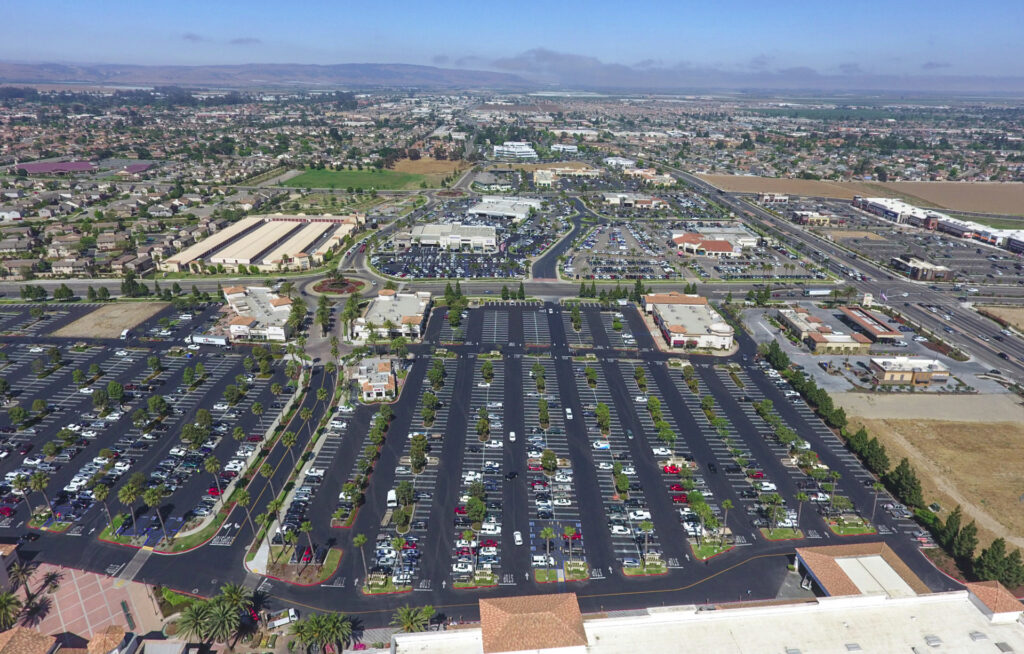
Were it not for this extreme transformation – all the highways, parking lots, streets widened with extra lanes, turning lanes, parking lanes, parking structures, etc, cars would not be convenient.
Congestion
The second reason cars provide the illusion of convenience relates to the space the cars themselves take up – in a word, congestion. Let’s take another look at the photo of how much space 60 cars take up versus 60 bikes and a single bus capable of transporting 60 people:
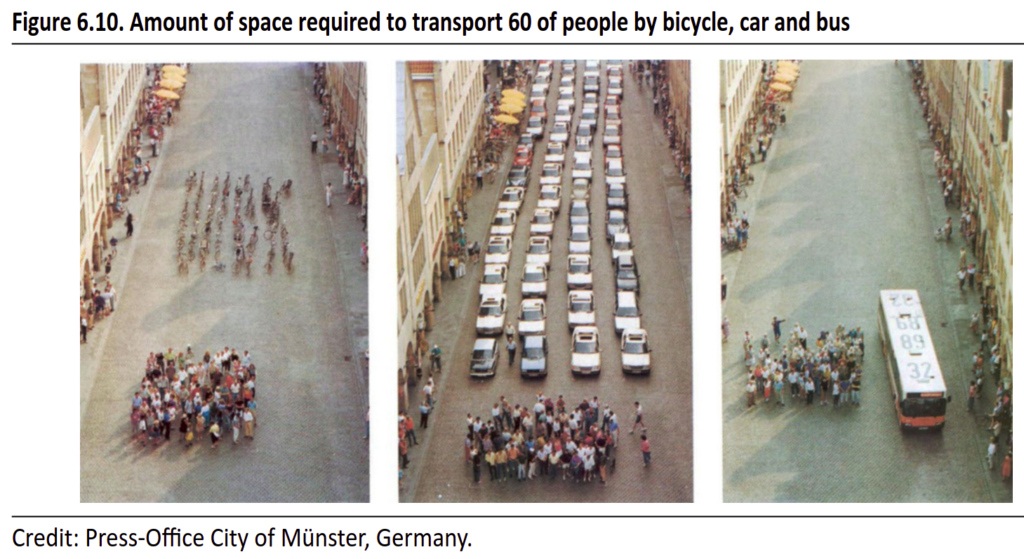
As discussed above, even well-served bus lines run at a frequency of one bus every 10 to 20 minutes. Though a bus is substantially larger than a car, buses do not add to congestion because there are so few of them. If everyone got around by bus, there would be no congestion whatsoever. But when everyone is in their own car, congestion is the only possible result, as dramatically illustrated in the above photo. Donald Shoup, a UCLA urban planner who studied the hidden costs of parking, remarked: “A place like Los Angeles, the total is so much less than the sum of the parts. There are so many wonderful things here but they’re so far apart and the congestion is so terrible you just don’t go there.”
Daniel Knowles made a similar point about Houston:
It has a thriving medical industry, a wonderful art museum, and a fantastic restaurant scene…You can eat at a Nigerian restaurant, hop to a Mexican bar, and finish in a Korean karaoke club. But few tourists realize it, because to experience it all, you have to be willing to drive everywhere, on endless confusing motorways, and sit in traffic for hours.
Crucially, there is no solution to congestion except reducing the number of cars on the road. It may seem logical that, if a road is so full of cars that traffic is frequently at a standstill, adding a lane to accommodate the volume of cars would solve the problem. But this is not so. When roads or highways are widened to relieve congestion, people drive more, leading to the same level of congestion as before the expansion. A review article concluded: “There is little dispute among transportation researchers that expanding highway capacity increases vehicle use…Research studies since the 1960s have suggested that over time and without any other offsetting deterrent, rush-hour traffic speeds tend to revert to their pre-expansion levels.” And, “The research found that sprawling metros exhibited the same levels of congestion delay as other regions.” This is a robust finding, holding true around the world and over several decades.
From this seemingly illogical effect, we can see how both the space requirements of roads and parking and the difficulty of moving so many bulky cars around intersect to produce a miserable, inefficient transportation system. From 1993 to 2017, the US population grew by 32%, and the number of freeway lane miles increased by 42%. But congestion increased by a whopping 144%(!), and the average American drove more, from 21 miles per day in 1993 to 25 miles per day in 2017. Again, this is summed up well by Samuel Schwartz, former NYC traffic commissioner, who explained how New York learned this the hard way: “No matter how many roads we built, or how well, people weren’t getting from point A to point B any faster, because points A and B were getting further apart…transportation had fallen into a vicious cycle in which more and more resources were being spent to less and less effect.” Building more car infrastructure (roads, highways, parking spots) doesn’t reduce congestion; rather, it leads to larger stretches between destinations, necessitating more miles driven, and therefore more overall congestion.
Putting this all together, our transportation system is full of unnecessary delay and gridlock. There is no way to reduce these delays except by having fewer cars on the road. Were we to reduce the number of cars on the road while investing in our ability to walk, bike, and take public transit instead, we would all be better off. Everyone could get from place to place more quickly.
Because we’ve covered so much information, it is worth pausing to remember the vision we are working towards. According to the models discussed in Chapter 3, we can reduce the mineral needs of a green energy transition for passenger transportation by three-quarters through investing in rail, bus, bike, and walking infrastructure, thus making cars unnecessary except in rural areas (the models discussed in Chapter 3 assumed that people in rural areas would not have access to mass transit and would get around by electric cars). This is not an unachievable vision. Remember, in 1910, every American town with at least 10,000 people had a streetcar line, and even small towns were well-connected to each other by rail. You would not have to live in an urban center to be better off in a transportation system that reduces our reliance on cars. Moreover, as discussed in Chapter 3, many of the necessary reforms could be implemented nearly overnight (eliminating fares on buses, signs and barriers to create bike lanes, etc.) or very quickly (more buses to expand routes and increase service frequency, redesigning routes to better meet people’s needs, etc.). Setting aside the climate imperative of doing so, we would all be better off if we phased out cars, and unlike proposals to replace all 350 million gasoline-powered cars in the US with electric cars, phasing out cars is actually achievable in the few years we have left to avoid catastrophic climate change.
_________________________________
Most recent issues
Issue 1 | Climate change and drinking water
Issue 2 | Green energy and electric cars
–
______________________
Financial security
So far, we have seen that phasing out cars would make transportation substantially more efficient and convenient. We could all get from place to place more quickly if we phased out cars and invested in our ability to get around by walking, biking, and public transit.
But there are so many other reasons why phasing out cars would make your life better – starting with your finances. The average new car costs a whopping $50,000, and the median used car costs nearly $30,000. Borrowers typically pay a whopping 7% interest rate for car loans (as we pointed out in Iss1/Ch3, student loans have reached a crisis with just 5.8% average interest rate), and the median monthly car payment is a whopping $754. The average car loan term is 6 years, and for used car purchases, the average car age is 6.5 years – meaning in practice, people don’t have much time between paying off a car loan and needing to take out a new loan to buy another car. According to the latest data, car insurance averages nearly $2000 to more than $2600 per year. The average American household pays $2000 to $3000 per year for gas each year – remarkably, this average even includes nondriving households that spend nothing on gas. Even more remarkably, these data were collected prior to the war in Iran, which has led to substantially higher gas prices.
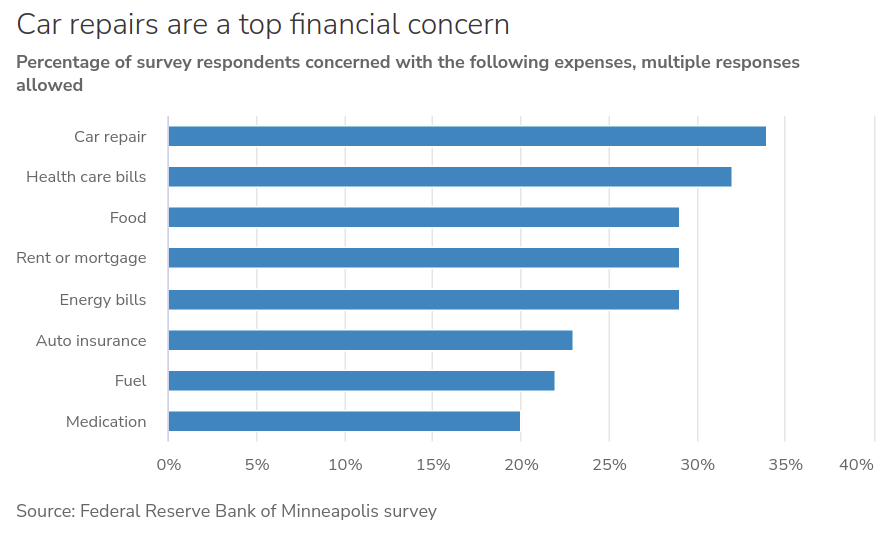
Adding all this up, the average running costs for a vehicle are so high that switching to getting around by public transit would save a typical American household $13,000 per year, even after accounting for the cost of fares. But even this shocking figure masks a great deal of hardship car ownership imposes, for several reasons. First, that $13,000 figure smooths out the distribution of a car’s maintenance costs over the lifetime of the vehicle by assuming drivers pay the same amount on maintenance every year. In reality, maintenance costs come in the form of large, unexpected bills. While oil changes and brake service are due at regular intervals and thus easier to budget for, unexpected repairs can mean catastrophe for those with limited financial means. Car repairs can cost thousands of dollars if there is an engine or transmission problem, for example, and nearly 40% of Americans would not be able to come up with $400 in an emergency. Most Americans commute by car, so car troubles literally lead to homelessness. That’s probably why, in a survey of upper Midwest and mountain state drivers, worries about car maintenance surpassed all other household cost concerns:
The second way the $13,000 figure masks a great deal of financial hardship is that, for the poorest 20% of Americans, their car eats up a third or more of their income, taking food out of their mouths. If no car means you can’t get to work, then you have to prioritize your car over other expenses, like food or health insurance. Finally, those of limited financial means don’t have access to good loan terms, and interest rates can soar to more than 20% (p40; again, student loans have reached a crisis with 5.8% interest rates). High interest rates mean higher monthly payments and longer loan terms: 20% of car payments exceed $1000 per month, and 22% of car loan terms last 7 years or longer. With interest rates so high, the amount owed grows faster than people can pay it off, and it is not unusual for people to owe more on their auto loan than their car is worth. A substantial portion of Americans are buckling under these costs: a shocking 4-5% of all US vehicle loans are at least 90 days delinquent at any given time. Each year, between 1 and 1.7 million car owners in the US fall so far behind on vehicle loan payments that their vehicle is repossessed. Unaffordable auto loans are now a leading cause of bankruptcy.
So, foregoing a car and using public transportation would save a typical household $13,000 each year, and public transportation is easy to budget for: you know exactly how much a fare or ticket costs, you know how much a pass will save you, and there are no catastrophic unexpected costs like a blown transmission. This means that establishing a good public transportation system would serve as a key antipoverty policy – it would not only substantially lower the cost of living and the number of people locked into punishing subprime loans, but also vastly reduce the risk of devastating and unaffordable repairs that cause people to lose their jobs or otherwise face financial ruin. For those not in desperate poverty, not having to spend $13,000 on a car each year would be real money to use on anything else – paying down debts, a down payment on a house, a vacation.
A free parking spot costs $50,000
The direct financial costs of driving – gasoline and insurance, for example – are easy to understand. Far less obvious are the indirect costs. Above, we pointed out that there is an enormous subsidy to drivers in the form of parking; in this section, we will look at research that tries to quantify how much this all costs.
Another astronomical – but easy to overlook – cost of cars is parking lots and structures. Many assume that large parking lots are built in response to the demands of the free market: if there weren’t available parking, people wouldn’t visit businesses or rent units of housing. In fact, the opposite is true: governments require buildings to meet minimum parking mandates, and people drive because the ample free parking ensures that driving is the most convenient option. As we saw above, when people have to pay a few dollars for parking, many find some other means of transportation. Parking isn’t abundant because the free market demands it; parking is abundant because the government mandates it be so. There is no difference between government minimum parking mandates and government mandates forcing business owners to pay the bus fare of patrons who took the bus to get there, or contributing to a sneaker fund for patrons who walked (though the latter mandates would be cheaper).
By forcing developers to meet parking requirements, enormous costs are added to any building development (see a much longer discussion here). According to the most recent data, building an above-ground parking structure, on average, costs between $114 to $165 per square foot (depending on location, surface it is being built on, etc.), and building underground parking beneath a building costs between $157 and $239 per square foot. A parking spot is 330 square feet (including space between rows for cars to drive through), meaning an aboveground parking structure costs $37,620 to $54,450 per space and underground parking costs between $51,810 and $78,870 per space.* This broadly agrees with a 2018 Government Accountability Office calculation (p31) that parking spots add 27% to the per-unit cost of building an apartment, or $56,000 per unit. Shockingly, parking spots cost more than most brand new cars, and the cost of constructing parking spots is passed along to tenants in the form of higher rent, customers in the form of higher prices, and employees in the form of lower wages.
The cost of parking adds up quickly because there are substantially more parking spots than there are cars. After all, if there is no open spot available when a driver arrives at the grocery store, for example, the driver can’t actually complete the trip to get groceries. Thus, at any time, the vast majority of parking spots must necessarily be vacant. As of 2010, the US had between 820 million and 2 billion parking spaces (scenarios 3-5), but only 350 million cars. The Houston metro area has almost 200 million parking spots, or about 30 parking spots for every resident. In other words, when estimating the cost to society of parking, it is key to remember not only the cost of each individual space, but the fact that there must be several parking spots per car.
How much does all this parking cost? A 1991 study of the cost of parking estimated that the annualized capital costs (the total cost spent to acquire land and build a parking spot; discussed in ch7 and here) and annual operating costs (snow plowing, resurfacing, maintenance, etc) of parking spots totalled $79 to $226 billion per year. Since drivers paid only $3 billion directly for parking (meters, parking passes, etc), the total societal or indirect subsidy for parking was between $76 and $223 billion per year. Adjusted for inflation, that would be $180 to $527 billion in 2025. However, we have substantially more parking spots in 2025 compared to 1991, and construction costs have grown substantially since 1991 as well. In other words, building and operating parking costs upwards of a trillion dollars each year, all passed on to consumers in the form of higher prices, employees in the form of lower wages, and tenants in the form of higher rents.
Another key issue (ch6) is that mandatory parking spot minimums lead to less housing being built, for several reasons. First, parking takes up scarce space. Second, if developers have to spend 27% or more per unit to build parking, there will be less money to build housing. Third, it is easier for developers to meet minimum parking requirements by making fewer units. For example, a 6000-square-foot floor in a building could contain six 1000-square-foot units or two 3000-square-foot units, but building six small units would require three times as many parking spaces as building two large units. Since each parking space costs $50,000 or more to build, housing developers are highly incentivized to build larger, more luxurious housing units, rather than smaller, more affordable apartments. Fourth, the concept of cut points biases projects in favor of fewer units. For example, if there is room for ten cars per floor of a parking garage and each unit is required by law to have one parking space, then a new apartment building will certainly have ten units, even if there is room for eleven: building an eleventh unit means that a second floor of parking must be constructed. Unless the developer can find a way to build 20 units, it makes no sense to build more than ten units. Additionally, adding another floor of parking to a planned parking structure reduces the number of spaces that can be built on each floor because the ramp connecting the floors takes up space that could have held parking spots.
Multiple studies (ch6) find that parking requirements lead to a dramatic reduction in housing construction. One examined apartment buildings constructed in the 4 years before, and 2 years after Oakland instituted a minimum parking ordinance of one space per dwelling: the number of housing units per lot fell by a whopping 30%. A modest requirement of only one parking spot per unit spurred this dramatic effect, but some cities have had parking requirements as high as 3.5 spaces per unit(!).
Clearly, parking requirements lead to the construction of substantially fewer housing units, and fewer housing units in the market push rents higher. As more people compete for a smaller pool of homes, prices are driven up – though it would be impossible to calculate exactly how much.
Some studies attempt to calculate how much of the cost of parking is passed onto renters. A study in Seattle found that “landlords’ losses on parking, calculated as the difference between total parking costs and total parking fees collected from tenants,” add up to roughly 15% of monthly rents. In other words, because landlords pass the cost of parking onto tenants in the form of higher rent, the high cost of apartment parking spots led to 15% higher rents. Ironically, in the study’s sample, 20% of tenants did not own a car and were thus paying 15% higher rents to subsidize the parking of their neighbors who did. Another study found that, for metropolitan areas across the US, parking spots added 17% to rent, meaning that all renters without cars are paying, in total, $440 million every year in higher rents to subsidize parking for their neighbors.
The story for businesses is very similar. Meeting minimum parking regulations generally requires 1.5 square feet of parking for every one square foot of the building housing the business itself. Because parking structures are so expensive, it is almost always more economical to meet parking requirements with a surface lot. However, surface lots require the business or commercial landlord to buy 2.5 times as much land as is needed for the business alone: for every 1 square foot of business, 1.5 square feet of additional land must be bought for parking. Buying so much extra land leads to higher financing costs and property taxes, all of which are passed along to consumers in the form of higher prices and employees in the form of lower wages. The maintenance costs of parking, from resurfacing to snow plowing, are also passed along to consumers and employees. Whether or not you own a car, you pay for parking in the form of higher prices and lower wages.
In sum, parking creates incalculable costs passed along to renters in the form of higher rents, customers in the form of higher prices, and employees in the form of lower wages. Remember, construction and maintenance costs of parking lots have been estimated to be as high as half a trillion dollars per year, rents are estimated to be 15-17% higher, and we do not have a way of quantifying many costs, like the fact that parking requirements lead to less housing construction, and therefore higher rents.
If it weren’t for this extraordinary direct and indirect subsidy that ensures ample parking everywhere, driving would not be the most convenient form of transportation: it would be impossible.
Public spending
Federal, state, and local governments spend hundreds of billions of dollars on roads. Much of this spending would not be necessary but for the spatial needs of cars, plus the accelerated wear and tear caused by so many vehicles driving on them. Many roads could be narrower if not for all the cars, and highways would be unnecessary. All that tax money could be put towards something else.
But it turns out that this is a significant undercount of the added infrastructure costs imposed by cars. As discussed above, we have rebuilt our world by spreading everything out to make room for wider roads and parking lots. This has dramatically increased infrastructure costs. Water mains, sewer lines, electrical lines, roads, sidewalks, fiber optic cables for internet access, etc, must be longer and longer to reach everything. When each business in an area built before cars might be touching existing ones, adding one more connection requires a tiny extension of utility lines. But for an area built for cars, each business might be a quarter mile away from the next business due to its huge parking lot. Again, parking spots in Houston alone take up the space of Paris times ten; all that open space must be crisscrossed by sewer lines, water mains, electrical lines, roads, sidewalks, fiber optic cables, etc. The added infrastructure costs are astronomical: spread-out, car-friendly development was estimated to cost an extra $12.6 billion on water and sewer infrastructure alone over 25 years. In other words, billions of dollars of taxes are paying for unnecessary infrastructure.
Finally, fossil fuel companies are extensively subsidized, as we pointed out in Iss1/Ch4, and all the foregone tax revenue could be put to other purposes.
____________________________________
Featured Excerpts
Apocalypse Nord (Iss1/Ch4)
These policies led to the Great Depression…what could go wrong? (Iss1/Ch3)
The carbon footprint on the back of the climate movement (Iss2/Ch3)
Independence* Day (Iss1/Ch2)
The green energy deal with the devil (Iss2/Ch2)
Are we measuring global poverty or intentionally underestimating it? (Iss1/Ch1)
__________
__________
Health
So far, we’ve seen that you could get around more easily and more quickly if we phased out cars, and that you would be substantially more financially secure.
But we would also be substantially healthier if we phased out cars.
Sedentary lifestyles: the silent killer
Many studies have found that spending hours per day sitting – whether working a desk job or watching TV – dramatically increases the risk of dying, especially from heart conditions, but also from cancer. It also substantially increases the risk of dementia. Because driving requires you to sit, driving adds to the time you sit each day and thus increases your risk of dying. By contrast, biking, walking, or walking to a bus stop reduces your time sitting, potentially adding years to your life.
Studies examining walking specifically showed surprisingly large benefits. A 10-year-long study showed substantially fewer deaths among people who walked (study participants who walked least were 16 times more likely to die than the participants who walked most), and surprisingly, walking briskly did not confer any benefits over walking slowly. To live longer, just walk; if you change from driving to work to walking or taking the bus (which requires some walking), you could literally add years to your life.
Beyond sitting, studies on driving specifically find strong links to increased health problems and mortality. The risk of heart attack triples in the hour after driving, likely due to the anger and stress inherent to driving. A systematic review found compelling evidence that driving leads to obesity. A study in the UK found that
compared with commuting by private motorised vehicle, bicycle commuting was associated with a 20% reduced rate of all-cause mortality, a 24% decreased rate of cardiovascular disease mortality, a 16% lower rate of cancer mortality, and an 11% reduced rate of incident cancer. Compared with commuting by private motorised vehicle, rail commuters had a 10% lower rate of all-cause mortality and a 21% decreased rate of cardiovascular disease mortality, in addition to a 12% reduced rate of incident cancer. Walk commuting was associated with 7% lower cancer incidence.
Remarkably, these results held for all socioeconomic groups. While wealth generally leads to better health outcomes, even the rich are susceptible to the health risks of driving.
After controlling for socioeconomic status, another study found that “Each additional hour spent in a car per day was associated with a 6% increase in the likelihood of obesity. Conversely, each additional kilometer walked per day was associated with a 4.8% reduction in the likelihood of obesity.” Countries with higher amounts of driving have higher obesity rates. Obesity rates in the US have increased in lockstep with the amount Americans drive. Another study found that longer car commutes were associated with worse cardiorespiratory fitness, higher BMI and waist circumference, higher blood pressure, and worse metabolic indicators (indicating diabetes or prediabetes). However, when controlled for the amount of time people spent on physical activity and their fitness levels, only the association between driving and high blood pressure remained. Put another way, working out cannot make up for the detrimental effects of driving on blood pressure, an important risk factor for heart attack and stroke. But these findings remain an indictment of cars: the reason people have so little physical activity and are so unfit is because of all the driving. If they were commuting by bike or walking, their entire commute would be exercise, and if they were commuting by public transit, some would be exercise (walking to the bus stop).
Studies examining biking specifically demonstrate substantial health benefits. For example, bike commuters in Scotland were found to have lower risk of dying, lower risk of any type of hospitalization, lower risk of hospitalization for a cardiovascular condition, lower risk of needing a prescription for a cardiovascular or mental health condition, and lower cancer mortality. A study in the Netherlands reached similar conclusions: the health benefits of biking exceed the risks of biking by nine times. The benefits of biking would have been even greater if not for cars, as the primary health risks of biking – being hit by a car and having higher exposure to air pollution – are not dangers inherent to biking, but dangers created by cars. In sum, when cities encourage biking by making it safer, they are potentially adding years to their citizens’ lives.
In the aggregate, the health impacts of phasing out cars would be enormous given the well-documented health benefits of traveling by walking, public transit, or bike. This is especially true because Americans already get very little physical activity: a quarter of all Americans do not walk or bike for even a ten-minute stretch once per week, and the average US adult spends 9.5 hours per day sitting. Given the well-documented health risks of spending so much time sitting, we could greatly increase life expectancy in the US by phasing out cars.
Air pollution: the silent killer
Globally, 8 million people die every year from the effects of air pollution, making air pollution the second leading cause of death. In the US, 200,000 die from air pollution every year, or more than ten times the number of Americans murdered. Living near a busy road permanently stunts the growth of children’s lungs by 12.5%, and for adults, increases the risk of lung cancer (by 9.7%), cardiac arrest (3%), and stroke (10.2%).
Electric cars would eliminate much, but not all, of this pollution. Crucially, electric cars create more particulate pollution than gasoline-powered cars. Particulate pollution does not originate from exhaust, but from tire and brake dust. Electric cars weigh more than gasoline-powered cars, and that added weight means more wear and tear on tires, brakes, and the roads themselves – and thus more particulates. As discussed in Chapter 2, particulate pollution is a well-established cause of heart attacks and other conditions, as well as early death. The amount of particulate pollution is enormous:
“We came to a bewildering amount of material being released into the environment – 300,000 tonnes of tyre rubber in the UK and US, just from cars and vans every year….There are hundreds and hundreds of chemicals, many of which are carcinogenic…When you multiply it by the total wear rates, you get to some very staggering figures as to what’s being released.”
Car accidents: the noisy killer
About 40,000 Americans die in car accidents each year, or roughly double the number of Americans who die from murder. 3.8 million Americans are seen in hospital emergency departments for car accidents each year (p26, Motor Vehicle—Traffic). 1.2 million Americans are living with disabilities from a car accident.** Worldwide, 1.19 million people die annually from car accidents, or more than ten times the number that die in armed conflict. A transition to electric cars would increase the number of deaths, injuries, and disabilities from car accidents because electric cars are heavier than gasoline-powered cars, so collisions would be more deadly.
Compared to driving, public transportation has a 90% lower fatality rate per mile; since the vast majority of traffic accidents involving public transit also involve cars, the already-low fatality rate of public transportation would be even lower if cars were phased out. Similarly, fatal bike accidents almost always involve cars.
Pedestrian strikes / bike accidents
More than 7000 pedestrians are killed every year by cars, with substantially more hospitalized after being struck by a car. More than 1000 cyclists are killed each year by cars, with substantially more hospitalized. This bloodbath is especially cruel because these thousands of people did not get behind the wheel and assume the risks of driving, but were nonetheless killed by drivers. Some of these victims chose not to drive out of environmental concerns.
Phasing out cars would eliminate thousands of pedestrian and cyclist deaths and tens of thousands of injuries each year.
Driving sucks, and parking lots are ugly: less-tangible benefits of phasing out cars
There are other, less tangible – though very real – reasons why your life would be better if we phased out cars.
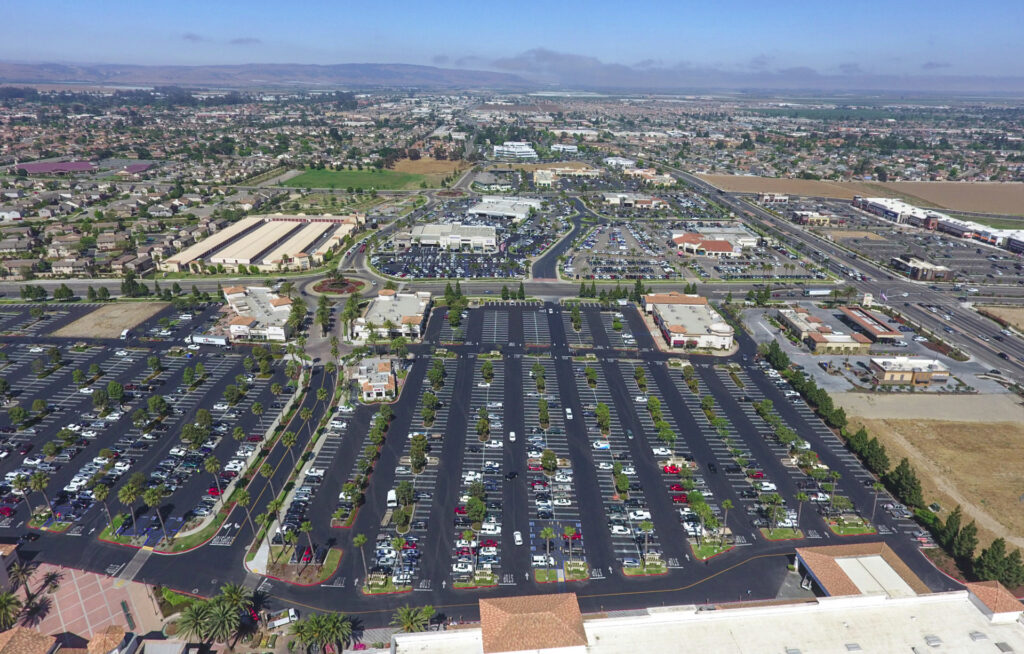
In popular parlance, “parking lot” is a synonym for ugly. If parking lots were turned into parks or given over to nature, our world would be a much more beautiful place. There is a reason people like vacationing in places with very little parking:
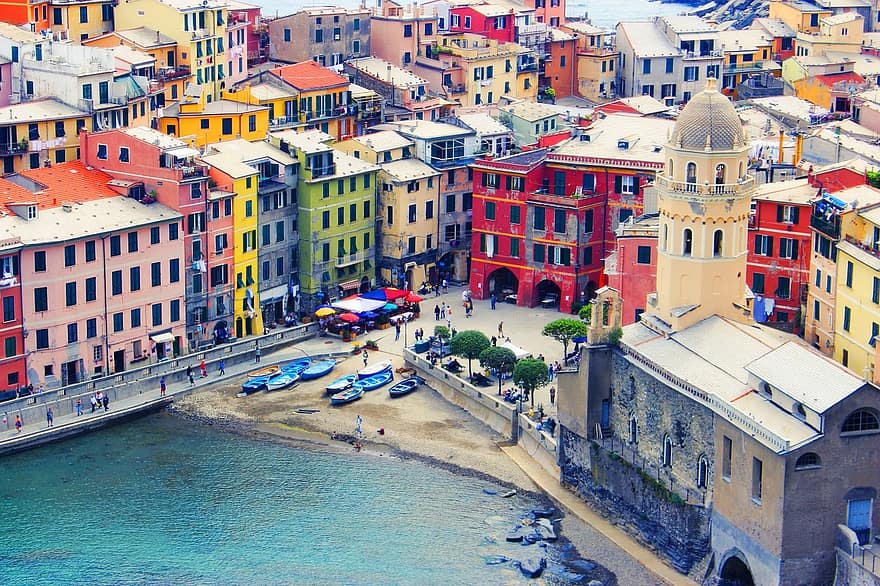
and not places with adequate parking:
Large parking lots make it impossible to walk from place to place, because instead of having dozens of businesses situated on the same block, each business might be a quarter mile or more apart to accommodate the necessary parking lots. While we discussed how this was inefficient above, here we look at the fact that walking is a more preferred mode of transportation. Daniel Knowles summarizes the survey evidence:
According to polling by Pew, around 40 percent of Americans would prefer to live in walkable neighborhoods, even if it means having smaller homes. And that polling was done in 2020, when the benefits of living in a dense urban core were significantly reduced, thanks to COVID-19, meaning bars and restaurants and the like were closed. An earlier poll, taken in 2017 by the National Association of Realtors, showed that more than half of Americans would prefer to live in walkable neighborhoods with smaller homes…Another poll conducted in 2020 by the National Association of Realtors found that one in five Americans would prefer to move from a larger detached home to a smaller one if it meant that they could walk more and have a shorter car commute, whereas only one in ten reported the opposite. People who report living in communities where “there are lots of places to walk nearby such as shops, cafes, and restaurants,” according to the poll, have much higher reported levels of happiness than people who report the opposite. A study published in 2022 by researchers at McGill University found that most car commuters want to walk and cycle more, and drive less. Almost nobody reports wanting to drive more. Car commuters are far more likely to agree with the statement “the only good thing about my travel is arriving at my destination” than anyone else.
Unsurprisingly, spending on sidewalks and bike infrastructure enjoys massive, bipartisan support.
Devoting so much space to parking and roads necessarily destroys natural habitats. Remember, parking spots in Houston alone take up the space of Paris times ten. There could be ten Paris’s worth of natural space in and around Houston if not for cars. As of 2010, the US has between 820 million and 2 billion parking spaces (scenarios 3-5). Assuming 330 square feet per space, that is between 9,706 and 23,674 square miles. The entire state of Maryland is 9,707 square miles, and West Virginia is 24,038 square miles – meaning wilderness the size of a small-to-medium US state has been eliminated just to make room for parking spots. More important than the opportunity to replace parking lots with green spaces within our towns and cities is that, without parking lots, our towns and cities could be more compact, leaving more room for nature outside city limits. Again, those are 2010 estimates; since 2010, we have built substantially more parking spots. Additionally, roads and parking lots cannot absorb rainwater, so rains immediately flow off, and flooding is the only possible result. Runoff from streets and parking lots also carries pollutants and silt, resulting in polluted and silted rivers.
We also know driving is miserable because of road rage. 483 Americans were shot in road rage incidents in 2023.
Unlike the studies on health discussed above, which definitively demonstrate that driving is bad for health, studies on psychological well-being are mixed, with some finding that biking, walking, and public transit commuters are psychologically better off than drivers, and some not finding any effect. However, this discrepancy is certainly due to cars. As discussed throughout, taking the bus would be so much faster and more convenient without all the congestion – congestion caused by cars, not buses. And our public transit system is so anemic, it’s no wonder people are frustrated with it. Similarly, as we saw above, biking and walking are very dangerous due to all the cars. If biking and walking are unpleasant, it is because of the noise, pollution, and danger of all the cars. Cars make transportation worse for everyone.
Cars are noisy and dangerous. When people say they don’t like cities, they almost always mean they don’t like cars. George Monbiot explains:
Traffic mutes community, as the noise, danger and pollution in busy streets drive people indoors. The places in which children could play and adults could sit and talk are reserved instead for parking. Engine noise, a great but scarcely acknowledged cause of stress and illness, fills our lives. As we jostle to secure our road space, as we swear and shake our fists at other drivers, pedestrians and cyclists, as we grumble about speed limits and traffic calming, cars change us, enhancing our sense of threat and competition, cutting us off from each other.
Undoing car infrastructure is popular, even among drivers. 70% of Londoners support the Low Traffic Neighborhoods program, which blocks certain streets to car traffic with inexpensive barriers like flower planters – even more drivers support than oppose the program. According to Daniel Knowles:
So far, no city that has closed a major road has felt it necessary to reopen it. Indeed, in most cases, the idea is unimaginable. Imagine flooding Times Square in New York or Trafalgar Square in London with vehicles again. It simply won’t happen.
There are more examples of successful, highly popular conversions of highways, busy roads, and parking lots into car-free zones than can possibly be summarized. But Copenhagen can stand in as an example:
After many years of pruning back pedestrian areas, Copenhagen was one of the first cities in Europe to grasp the nettle in the early 1960s and begin reducing car traffic and parking in the city center in order to create once again better space for city life.
Copenhagen’s traditional main street, Stroget, was converted to a pedestrian promenade already in 1962. Skepticism abounded. Would a project like this really succeed so far north?
After only a short period it was clear that the project was enjoying greater success faster thank anyone had anticipated. The number of pedestrians rose 35% in the first year alone….Since then, more streets have been converted for pedestrian traffic and city life, and one by one the parking places in the city center have been turned into squares that accommodate public life.
Similarly, in 2007, the center of Ljubljana, Slovenia, was closed to cars.
“Everybody said the city was going to die. But actually, the opposite happened”. The air is cleaner, the city is greener and business is booming. These days, residents “can hardly remember” the city they used to live in, says Matic Sopotnik, a city official who works in the transport department.
Sign up here to be notified when a new issue of Finite is published (4 emails/year). Sign up here to receive every new article of Finite in your inbox as soon as it is published.
Transportation for people, not cars
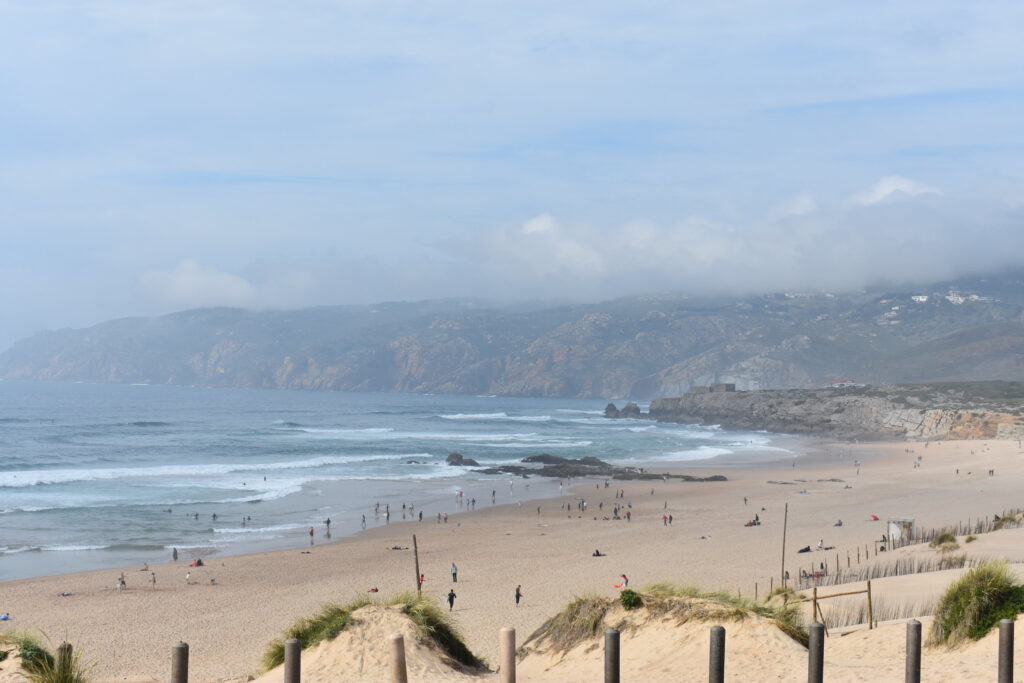
Phasing out cars would mean giving up road trips, but that should not mean giving up vacations. As discussed throughout, US cities used to be connected by an efficient network of rail. There’s no reason you couldn’t travel and have fun vacations if we phased out cars. That’s especially true because we can consciously design our transportation to offer people recreation opportunities. This is not without precedent, and there are too many examples to summarize here, but public transit serves the stunning Cascais beach in Portugal, and in the mid-1890s, a Milwaukee streetcar line was extended to serve an Olmsted-designed park.
We will all eventually lose the ability to drive. Injury, illness, or old age will render us unable to drive. You may get a temporary injury – like a broken leg – that prevents you from driving. If driving is the only way to get around, then injury, illness, or old age will trap you in your home. By contrast, all public transit buses are fully accessible, even to those with grievous injuries and all types of disabilities. 104 or 146 Chicago’s subway stations are fully accessible, and all 146 will be accessible by 2038; for New York City, a quarter of subway stations are accessible and 95% will be accessible by 2055. Public transportation is by far a better option for those with injuries and disabilities, and specialized cab service should be available to people whose disabilities prevent them from even riding a bus.
*I’m repeating analysis from Parking and the City, p81-82 but with more recent data.
**This is an old study, looking at 1995 data. Unfortunately, data on disability from car accidents are not collected; “lack of reliable data on non-fatal outcomes especially permanent disabilities after [car accidents] even in the countries where mortality statistics are assembled annually. Globally, routinely collected data on crash-related disability are non-existent or inaccessible.”